Greek Orthodox churches are beautiful and new inside. They generally look like they were repainted just last year. Perhaps they were. However, there's always an exception.
You know this. It's one of the buildings on the Acropolis. (Acro meaning highest point and Polis meaning town). What you see has mostly been restored from stones lying around. This is because the buildings on the Aropolis have been blown up at least twice in the past 300 years. Hint: If you are storing gunpowder to sustain your defences during a long siege, don't put it in the largest and most obvious building in the city...
To appreciate architecture, you must first learn to look up. To capture some forgotten nook or cranny you need to keep your camera with you. So if you spend your time looking down at your smartphone and staying connected, you may actually be missing a lot of the world, actually.
Never insult the carpenters and carvers who are working on your choir stalls. You may be immortalised in wood forever. (The others were worse than this one)
Somewhere is the south of France a few years ago. I wonder where it was? Such is the nature of our instant memories these days. Click. Move on. Forget. It's not Stoke on Trent, that's for sure.
Ah! The unusual angle.That always catches the viewer's attention. Go stand in the river (or what is left of it) to take a picture of the ancient pack horse bridge. In this case it is a strange narrow arrangement with low walls so the mules and horses could cross it without knocking the load off their backs. Then there is the vertical shot. Here we have a spiky tree in the land of Johnny Foreigner looking straight up. Honest.
Working with harsh lighting is a challenge. The rule is: Take all your pictures within an hour of sunrise or sunset when the light is at its best. Equally you could forget that rule, search out a character or some remarkable architecture and take a picture at midday anyway In this case I place the sun behind my subject and aim for an impressive silhouette. In this case it is the Roman aqueduct, an astonishing construction at Segovia.
My short attention span dictates that I often get bored when shopping* and I soon divert my gaze to the shop fittings.They are an endless source of interest to me. Here we have a large graphic on a wall in a local department store. At first sight it might be Roman numerals, perhaps part of some giant clock. Maybe this is actually a structural part of the building. But no: It is simply the word "denim" placed high on the wall for no apparent reason. Still, what do I know? *Obvously shopping for spanners is a completely different experience.
Normally I avoid including people in my landscape pictures. I like my countryside green and leafy and without cars (even though I drive everywhere..) However, sometimes including a person in a picture can create a sense of scale that would otherwise be absent.
A huge archaeological site in Jordan, mostly destroyed in the earthquake of 749. This is well worth a visit, but try to chose a cool part of the day. There's very little shade and there isn't even a tea shop. Harrumph.
Maybe this ultra-wide panorama (click for full size) gives a better impression of the Treasury in its environment. It is hard to imagine how this was constructed by cutting it out of solid rock. So here is your humble scribe taking in this World Heritage site.
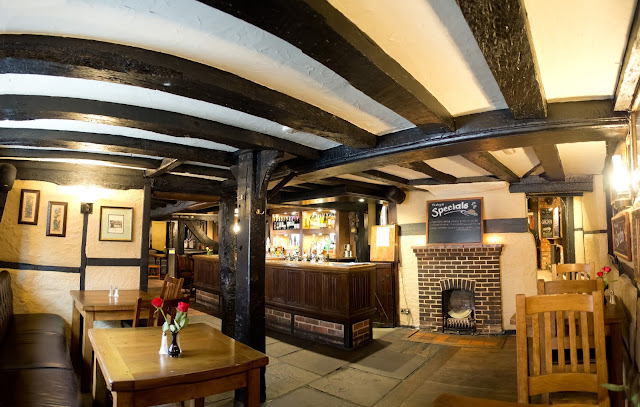
Ah! The New Inn, Salisbury. What a great pub. It looks like it has settled slowly into the ground, and the floor inside is indeed lower than the street outside. That is always a good sign as far as I am concerned. The architecture is as mad as a box of frogs and don't you just love the idea that a 13th century pub can be called the New Inn .
Something with classical overtones and very pleasing symmetry: The iron hand rails are particularly well presented. This is Kingston Maurward house in Dorset. A Georgian pile built by a Pitt, but now used as an agricultural college. The gardens are most pleasing and it is well worth a visit but it is, alas, not a National Trust property.
Well, here we are inside an early Norman or late Saxon church on a quiet March afternoon. The low spring sunshine illuminates the thousand year old round arch, the column ... and the LED fake candle.
Here is another case of "keeping your eyes open". When we visited the excellent St Cross almshouses a while back I spotted that the sunlight streaming in through a window was reflected off the shiny floor. This imparted a strange light to the stone pillars which had me reaching for my telephoto lens.